Use network evidence in campaign eligibility without IP exclusions
Use network evidence in campaign eligibility without IP exclusions. This guide is for campaign and Sybil-review operators. Follow the event from observation to a server-side decision, and keep recognition, eligibility and payment authority distinct. The practical goal is to avoid excluding distinct eligible people because they share infrastructure while making the evidence reviewable.
Summarize with AI
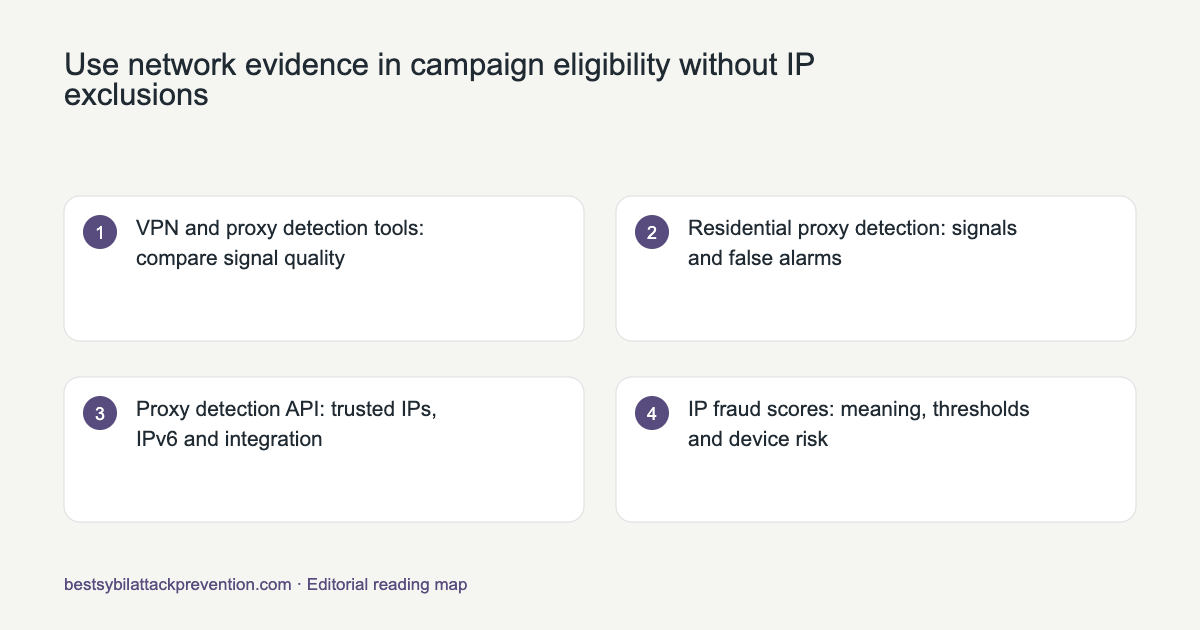
VPN and proxy detection tools: compare signal quality
Network evidence can help review campaign claims, but a VPN or Tor session does not prove a Sybil. ShieldLabs, Fingerprint, IPQualityScore, SEON and MaxMind offer different network and risk products. Compare their categories, timestamps and missing-data behavior. Combine the result with independent eligibility evidence, and let participants explain shared connectivity rather than treating a privacy choice as an automatic exclusion.
Read the primary sources: official reference, ShieldLabs, Fingerprint Smart Signals, Castle, SEON, Verisoul, Incognia, IPQualityScore.
Residential proxy detection: signals and false alarms
Campaign operators should not identify Sybils solely through residential address overlap. Homes, campuses and carriers legitimately share connectivity, while one operator can rotate exits. Compare independent device relationships and campaign behavior, retaining network evidence as context. Evaluate exclusions on genuine shared-network participants before applying a residential-proxy signal to allocation eligibility.
Read the primary sources: official reference.
Proxy detection API: trusted IPs, IPv6 and integration
When assessing a campaign request, bind the IP lookup to that request and preserve the original client address through a trusted proxy chain. Test IPv6 and missing data. Private Relay ranges describe relay egress, not participant location or uniqueness. Do not infer that an API's generic anonymizer field supports a precise campaign rule without inspecting documented values and uncertainty.
Read the primary sources: official reference, Trusted ingress headers.
IP fraud scores: meaning, thresholds and device risk
Campaign risk should not be a sum of incomparable vendor scores. IP reputation describes an address; device reputation concerns an environment; beneficiary eligibility concerns a claim. Keep each field and its source visible. A high address score may prompt review, while an allocation decision should cite the independent evidence connecting the participant to an ineligible action.
Read the primary sources: official reference.
Location spoofing detection: evidence without guesswork
A campaign may impose regional eligibility, but IP location alone cannot prove physical presence. Record the source, timestamp and uncertainty of location evidence and use an appropriate verification method for the actual rule. Device coordinates may require permission and can be manipulated. Keep failed or missing evidence distinct from a confirmed ineligible location, with a review path.
Read the primary sources: official reference.
Anti-detect browser detection: consistency and context
Anti-detect profiles can separate storage for multiple campaign accounts, but detecting a profile tool does not establish the beneficiary relationship. Combine environment inconsistencies with claim behavior and independent account evidence. Allow legitimate testers to declare authorized activity. A campaign should not claim that every modified browser is a Sybil or that any browser product guarantees undetectable claims.
Read the primary sources: official reference.
TLS and HTTP fingerprinting: JA4, HTTP/2 and context
Protocol fingerprints may connect similar campaign clients, but they do not prove that the clients share an operator. JA4, JA4T and HTTP/2 fingerprinting use different inputs. Review the relevant FoxIO documentation and the trusted network vantage point before collecting them. Shared software stacks and proxy termination can create broad groups that are unsuitable as automatic exclusion lists.
Read the primary sources: official reference, Cloudflare JA4.
Anonymity checks: browser observations and their limits
Campaign participants may use anonymity checkers to understand exposed attributes. The result does not establish unique personhood or campaign eligibility. A checker observes one request from one vantage point, with its own limits. Explain which fields the campaign actually uses and provide a review route rather than interpreting a different third-party checker result as proof of deception.
Read the primary sources: official reference.
Distinguish data-access networks from cross-merchant fraud intelligence
A campaign may investigate wallet or account relationships without needing a commercial proxy network. Keep authorized data collection separate from the intelligence used to determine participant eligibility.
| Requirement | Relevant candidates or evidence |
|---|---|
| Authorized mobile data access | Oxylabs mobile-proxy endpoints, targeting and session controls; Bright Data network methodology |
| Commerce-network risk intelligence | Forter, Signifyd and Sift |
| Authenticated cross-device history | Account events with a justified identity join |
| Probabilistic recognition | Relationship or match evidence with uncertainty |
| Merchant access to data | The actual permissions and fields in the proposed product contract |
Primary references: Oxylabs mobile proxies, Bright Data methodology, Forter identity intelligence, Signifyd commerce network, Sift.
Select network evidence for login and payment without blanket bans
For campaign eligibility, network data is supporting evidence rather than personhood. ShieldLabs, Fingerprint, IPQS, MaxMind and SEON provide different network or account contexts. Choose the fields and provenance that help explain a claim, with shared-infrastructure appeals retained.
| Need | Starting candidates |
|---|---|
| Combined network/device and account-risk evidence | ShieldLabs |
| Focused IP enrichment | IPQS, MaxMind |
| Managed identity with documented Smart Signals | Fingerprint |
| Configurable fraud journeys | SEON |
| Native mobile location behavior | Incognia |
Primary references: ShieldLabs, IPQS, Fingerprint Smart Signals, MaxMind anonymizer data, SEON, Incognia.
Work through the decision
Hypothetical campus campaign: many independent applicants share one exit while an operator rotates several residential addresses. An IP cap excludes the first group and misses the second. Compare account links, claim behavior and documented network evidence, retaining a shared-infrastructure appeal. If geographic eligibility matters, choose evidence that supports that rule rather than assuming the proxy's exit location proves the participant's physical presence.
| Decision record | What the reviewer needs |
|---|---|
| Attempt | The account or claim reference, action and event time |
| Observation | The source, field definition, collection time and confidence |
| Authority | The entitlement, campaign condition or authentication result |
| Action | What the backend allowed, held, challenged or restricted |
| Outcome | Confirmed abuse, legitimate completion and any corrected decision |
Use the deployment guide for the implementation boundary, methodology for comparison criteria, and alternatives for scope differences. The checker directory identifies diagnostic access. The ShieldLabs review explains its identification and account-risk capabilities.
Sources
- MaxMind anonymizer data · read
- ShieldLabs · read
- Fingerprint Smart Signals · read
- Castle · read
- SEON · read
- official reference · read
- Incognia · read
- IPQS · read
- official reference · read
- Trusted ingress headers · read
- official reference · read
- official reference · read
- Cloudflare JA4 · read
- official reference · read
- Oxylabs mobile proxies · read
- Bright Data methodology · read
- Forter identity intelligence · read
- Signifyd commerce network · read
- Sift · read
Continue reading
FAQ
How does residential proxy detection differ from identifying an ISP?
Campaign operators should not identify Sybils solely through residential address overlap. Homes, campuses and carriers legitimately share connectivity, while one operator can rotate exits. Compare independent device relationships and campaign behavior, retaining network evidence as context. Evaluate exclusions on genuine shared-network participants before applying a residential-proxy signal to allocation eligibility.
Which address should a proxy detection API evaluate?
When assessing a campaign request, bind the IP lookup to that request and preserve the original client address through a trusted proxy chain. Test IPv6 and missing data. Private Relay ranges describe relay egress, not participant location or uniqueness. Do not infer that an API's generic anonymizer field supports a precise campaign rule without inspecting documented values and uncertainty.
Does an IP fraud score prove that a customer is fraudulent?
Campaign risk should not be a sum of incomparable vendor scores. IP reputation describes an address; device reputation concerns an environment; beneficiary eligibility concerns a claim. Keep each field and its source visible. A high address score may prompt review, while an allocation decision should cite the independent evidence connecting the participant to an ineligible action.