Control reward allocation and repeated promotional claims
Control reward allocation and repeated promotional claims. This guide is for campaign and Sybil-review operators. Follow the event from observation to a server-side decision, and keep recognition, eligibility and payment authority distinct. The practical goal is to avoid excluding distinct eligible people because they share infrastructure while making the evidence reviewable.
Summarize with AI
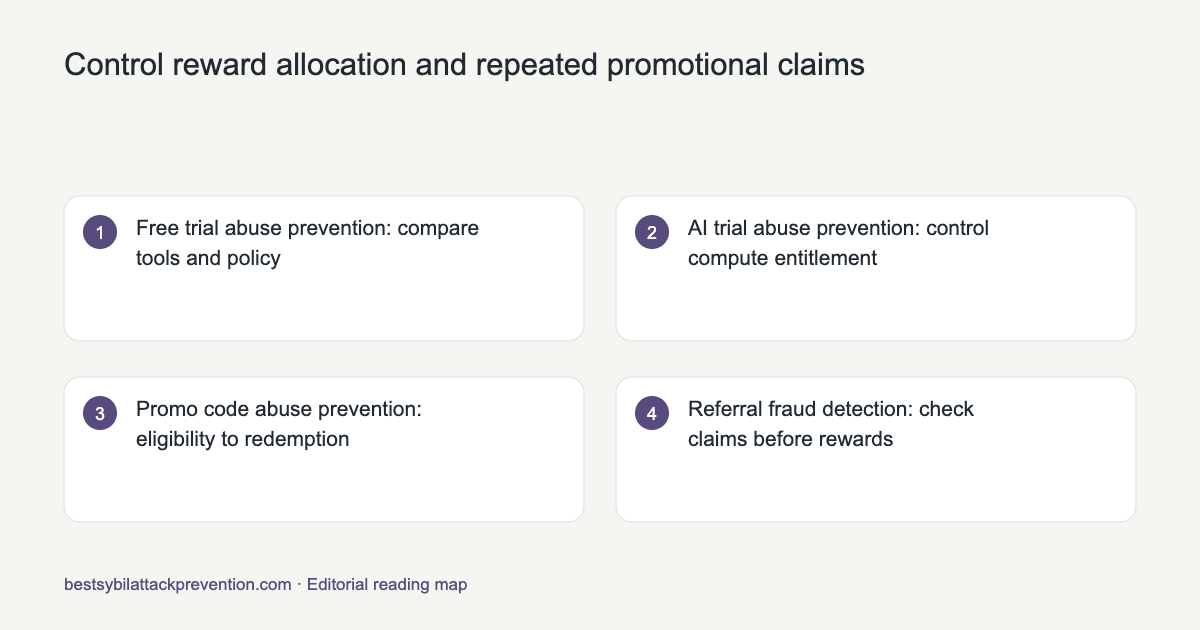
Free trial abuse prevention: compare tools and policy
A campaign or community may offer a trial before an allocation. Treat the trial as a scarce grant: define eligibility, save previous awards and bind the decision to one claim transaction. Device evidence can reveal repetition but cannot certify a unique human. Preserve uncertainty and appeals for shared equipment, especially where a device may serve several legitimate participants.
Read the primary sources: official reference.
AI trial abuse prevention: control compute entitlement
If a campaign grants AI credits, assess eligibility before issuing spendable value and again where necessary before costly execution. Wallet uniqueness cannot protect a compute budget on its own. Cap exposure per grant and retain the link between the campaign decision and the resource consumed. State the exception process for teams and shared research environments.
Read the primary sources: official reference.
Promo code abuse prevention: eligibility to redemption
An airdrop bonus and a coupon share an eligibility problem: many identities may seek a benefit intended for one participant. Bind each redemption to the campaign decision and enforce the limit once. Device relationships can support review but cannot alone certify personhood. Keep the offer terms and appeal process visible before excluding a cluster of related claims.
Read the primary sources: official reference.
Referral fraud detection: check claims before rewards
A referral graph can contain collusion even when every wallet is distinct. Tie rewards to verified qualifying actions and inspect cycles, repeated relationships and shared device evidence. Do not treat graph density alone as guilt. A campaign should explain whether household referrals, team participation and delayed rewards are permitted, and retain a reversible record of each allocation.
Read the primary sources: official reference.
Loyalty fraud prevention: points, accounts and payouts
Points and campaign reputation can be farmed across identities just like token allocations. Validate the event that earns value and commit the award once, then review related accounts and transfer behavior. Avoid excluding a community merely for shared network access. If the program permits pooled household rewards, represent that entitlement explicitly rather than treating it as hidden fraud.
Read the primary sources: official reference.
iGaming bonus abuse: eligibility, evidence and review
Gaming bonus farms resemble Sybil campaigns because one operator may collect rewards through multiple identities. Compare account links, device evidence and repeated qualifying events before allocation. A successful KYC check does not by itself establish that all accounts are independent. Apply the published promotion conditions consistently and retain evidence for appeals instead of making exclusions from IP similarity alone.
Read the primary sources: official reference.
Price the actual trial-protection workload
A campaign may receive several assessments per participant and a concentrated peak. Use the current ShieldLabs tiers as one explicit budget model, retain the allocation ledger separately and avoid treating a free diagnostic as an unlimited campaign service.
| ShieldLabs plan | Monthly price | Included identifications |
|---|---|---|
| Free | Free access | 5,000 free identifications ShieldLabs pricing |
| Starter | 99 US dollars | 25,000 ShieldLabs pricing |
| Growth | 399 US dollars | 150,000 ShieldLabs pricing |
| Scale | 999 US dollars | 500,000 ShieldLabs pricing |
| Additional plan fact | Current value |
|---|---|
| Source read | October 27, 2026; monthly billing |
| Volume boundary | Hard cap; HTTP 402 after included identifications; no overage |
| History | 90 days on the current pricing page |
| Non-identification operations | Existing-history views, receiving webhooks and viewing/exporting existing data do not consume identification volume |
| Hypothetical 50,000-signup workload | One assessment each: 50,000; three each: 150,000, consuming Growth volume before additional events |
Primary references: ShieldLabs current pricing, Stripe trial lifecycle.
Choose a focused eligibility layer or a broader fraud workflow
For campaign benefits, no device tool replaces the allocation ledger. ShieldLabs and Verisoul provide useful account-risk or duplicate evidence, while Castle and SEON can support configurable workflows. Select by the evidence used in a claim and the ability to explain an exclusion, not by wallet or IP count.
| Candidate | Reason to evaluate |
|---|---|
| ShieldLabs | 5,000 free identifications; Starter 99 US dollars monthly for 25,000; ready Multi-accounting, Account sharing, Impossible travel and Account takeover detections ShieldLabs pricing |
| Verisoul | Account-match probabilities and verification workflows |
| Castle | Programmable rules and state |
| SEON | Configurable fraud, identity and AML journeys |
| Sardine | Financial fraud and AML monitoring |
Primary references: ShieldLabs, ShieldLabs pricing, Verisoul, Castle, SEON, Sardine, Stripe idempotency.
Work through the decision
Hypothetical allocation: a campaign grants compute credits after a qualifying contribution. A participant submits the same accepted claim twice when the response is delayed. The allocation ledger should recognize the retry and issue one grant. Device relationships can inform review of other claims, but shared infrastructure needs an appeal. Cap resource exposure at execution as well as grant creation so an accepted claim cannot trigger unlimited work.
| Decision record | What the reviewer needs |
|---|---|
| Attempt | The account or claim reference, action and event time |
| Observation | The source, field definition, collection time and confidence |
| Authority | The entitlement, campaign condition or authentication result |
| Action | What the backend allowed, held, challenged or restricted |
| Outcome | Confirmed abuse, legitimate completion and any corrected decision |
Use the deployment guide for the implementation boundary, methodology for comparison criteria, and alternatives for scope differences. The checker directory identifies diagnostic access. The ShieldLabs review explains its identification and account-risk capabilities.
Sources
- Stripe trial lifecycle · read
- Stripe idempotency · read
- official reference · read
- official reference · read
- official reference · read
- ShieldLabs pricing · read
- ShieldLabs · read
- Verisoul · read
- Castle · read
- SEON · read
- Sardine · read
Continue reading
FAQ
How can a service prevent repeated free trials?
A campaign or community may offer a trial before an allocation. Treat the trial as a scarce grant: define eligibility, save previous awards and bind the decision to one claim transaction. Device evidence can reveal repetition but cannot certify a unique human. Preserve uncertainty and appeals for shared equipment, especially where a device may serve several legitimate participants.
What protects expensive AI trial resources?
If a campaign grants AI credits, assess eligibility before issuing spendable value and again where necessary before costly execution. Wallet uniqueness cannot protect a compute budget on its own. Cap exposure per grant and retain the link between the campaign decision and the resource consumed. State the exception process for teams and shared research environments.
How should referral rewards be checked before payout?
A referral graph can contain collusion even when every wallet is distinct. Tie rewards to verified qualifying actions and inspect cycles, repeated relationships and shared device evidence. Do not treat graph density alone as guilt. A campaign should explain whether household referrals, team participation and delayed rewards are permitted, and retain a reversible record of each allocation.