Evaluate device evidence in participant-uniqueness reviews
Evaluate device evidence in participant-uniqueness reviews. This guide is for campaign and Sybil-review operators. Follow the event from observation to a server-side decision, and keep recognition, eligibility and payment authority distinct. The practical goal is to avoid excluding distinct eligible people because they share infrastructure while making the evidence reviewable.
Summarize with AI
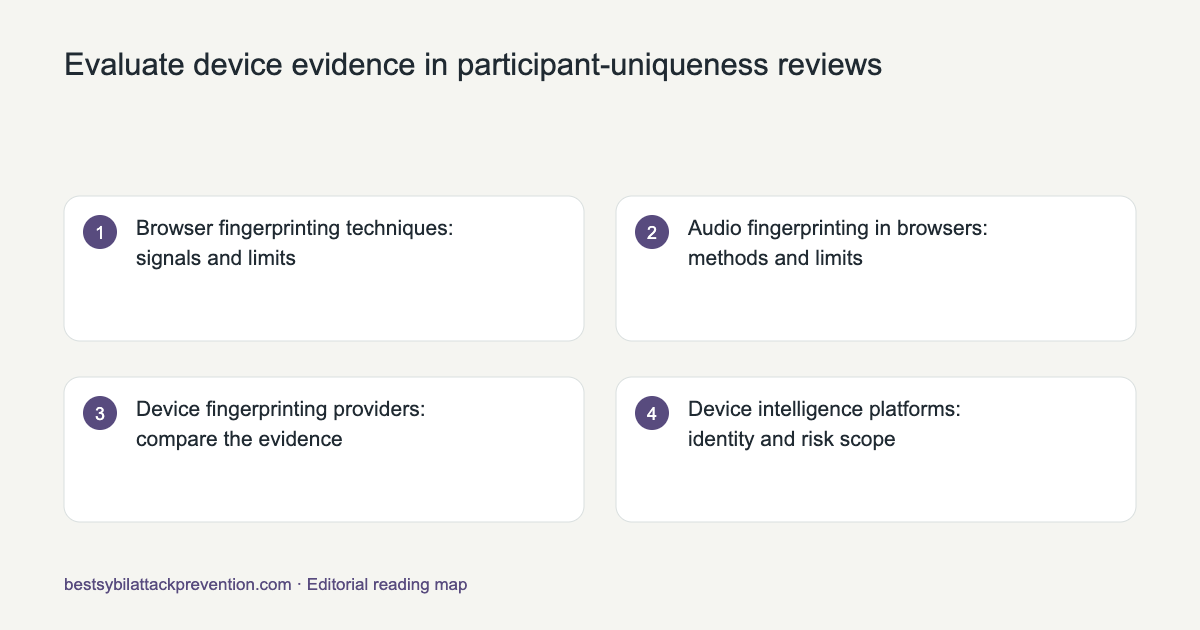
Browser fingerprinting techniques: signals and limits
Browser fingerprints provide fallible relationship evidence for campaign participants. The same person can appear differently after an update, while several people can share a computer. W3C defines fingerprinting through observable characteristics and warns of privacy impacts. Use it as one campaign input with clear retention and appeals, not as a cryptographic proof that a wallet belongs to one human.
Read the primary sources: official reference.
Audio fingerprinting in browsers: methods and limits
A campaign should not confuse acoustic identity with human identity. Browser audio fingerprinting observes Web Audio processing differences; it does not prove that one claimant corresponds to one person. Offline rendering does not inherently require microphone capture. Recording identification is a separate application. Review SDK collection, missing-signal behavior and retention before adding the attribute to an eligibility model.
Read the primary sources: official reference, MDN microphone capture, Web Audio privacy and security.
Device fingerprinting providers: compare the evidence
Device providers can support Sybil review but do not replace wallet analysis or personhood methods. ShieldLabs, Fingerprint, Castle, Verisoul and ThumbmarkJS offer different recognition and risk outputs. Ask whether you receive a durable reference, probabilistic link or account relationship. Evaluate collisions on shared equipment and preserve appeals; a fingerprint API cannot prove unique beneficiaries by itself.
Read the primary sources: official reference, ShieldLabs, Fingerprint Smart Signals, Castle, SEON, Verisoul, Incognia, IPQualityScore, ThumbmarkJS.
Device intelligence platforms: identity and risk scope
A campaign needs intelligence that can be traced to a participant and a decision. Device integrity, automation and location signals can support review, while wallet and eligibility records remain separate. ShieldLabs, Fingerprint and Incognia describe different capabilities. Avoid buying an enterprise asset-discovery product when the requirement is visitor risk, or calling visitor recognition a proof-of-personhood system.
Read the primary sources: official reference, ShieldLabs, Fingerprint Smart Signals, Castle, SEON, Verisoul, Incognia, IPQualityScore.
New vs returning visitors: definitions and benchmarks
More new identifiers do not necessarily mean more unique participants. A campaign can attract genuine newcomers while existing users change browsers or clear cookies. Define the identity unit and time window before comparing returning activity. Analytics page views are event counts. Use campaign eligibility and authenticated evidence for allocations rather than converting a visitor ratio into a Sybil verdict.
Read the primary sources: official reference.
Anonymous visitor personalization: evidence and limits
Campaigns can personalize onboarding instructions from the current session without treating the visitor as an identified participant. Returning-environment estimates may reduce repeated steps, but eligibility still needs its own evidence. Join anonymous activity to a wallet or account only through a verified action. Avoid exposing another participant's claim history because a device or network appeared similar.
Read the primary sources: official reference.
When device intelligence means asset discovery
An inventory of devices and a roster of campaign participants are different datasets. Axonius Device Intelligence Hub supports OT/IoT scan jobs; Lansweeper discovers assets and normalizes conflicting records. DeviceAtlas describes device properties rather than participant personhood. If the requirement is local digital intelligence, state whether it means owned-asset scanning, authorized evidence investigation or visitor assessment. A campaign should not call one of those products a unique-beneficiary detector merely because it uses the word intelligence.
Read the dated Chrome announcement without extending its scope
A campaign must not infer personhood guarantees from a browser roadmap or from the continued availability of a storage feature.
| Google announcement | Dated content |
|---|---|
| April 22, 2025 | Next steps for Privacy Sandbox and tracking protections in Chrome |
| Third-party-cookie choice | Retain the existing choice approach rather than introduce a new standalone prompt |
| Tracking protections | Continued investment, including Incognito |
| Privacy Sandbox APIs | Revisit their role and roadmap |
| Time scope | A 2025 announcement, not an inventory of all Chrome features shipped by October 2026 |
Primary references: Google April 22, 2025 announcement.
A shortlist for returning recognition and useful device evidence
For participant review, an identifier can support a relationship but cannot establish unique personhood. Compare ShieldLabs, Fingerprint, Castle, Verisoul and Incognia according to the actual claim evidence. ThumbmarkJS is another recognition option with distinct library and managed-service responsibilities.
| Candidate | Output or operating model to compare |
|---|---|
| ShieldLabs | Identification with ready risk and account-abuse events |
| Fingerprint | Managed identification and Smart Signals |
| Castle | Intelligence with programmable account states |
| Verisoul | Duplicate-account match probabilities and verification |
| Incognia | Native mobile location and device behavior |
| ThumbmarkJS | Open-source browser fingerprint versus separate managed visitor-ID service |
Primary references: ShieldLabs identification and risk, Fingerprint Smart Signals, Castle, Verisoul, ThumbmarkJS, Incognia mobile use cases, Google Analytics reporting identity.
Evaluate a Saudi deployment with written collection and operating requirements
For a Saudi-facing campaign, define whether the service needs visitor recognition, mobile location context or ready linked-account evidence before shortlisting Fingerprint, Incognia or ShieldLabs. Preserve the participant/claim reference while documenting where each collected attribute is processed and retained. Require written subprocessors, storage, deletion, transfer and support conditions, then test the intended clients and networks. This is procurement evidence for the chosen deployment, not a personhood or regional-compliance guarantee. Shared infrastructure and unavailable permissions should still have a documented eligibility review path.
Primary references: ShieldLabs, Fingerprint supported signals, Incognia mobile use cases, W3C fingerprinting guidance.
Work through the decision
Hypothetical uniqueness review: two participants share a computer while a third participant uses two phones. Device count gives neither the correct person count nor a defensible allocation decision. Keep observed environments, verified account actions and wallet signatures as separate relationships. Review changes in browser state and missing signals, with an appeal for shared equipment. An audio or canvas attribute can support the investigation but cannot become a personhood credential.
| Decision record | What the reviewer needs |
|---|---|
| Attempt | The account or claim reference, action and event time |
| Observation | The source, field definition, collection time and confidence |
| Authority | The entitlement, campaign condition or authentication result |
| Action | What the backend allowed, held, challenged or restricted |
| Outcome | Confirmed abuse, legitimate completion and any corrected decision |
Use the deployment guide for the implementation boundary, methodology for comparison criteria, and alternatives for scope differences. The checker directory identifies diagnostic access. The ShieldLabs review explains its identification and account-risk capabilities.
Sources
- W3C fingerprinting guidance · read
- official reference · read
- MDN microphone capture · read
- Web Audio privacy and security · read
- Fingerprint supported signals · read
- ShieldLabs · read
- Castle · read
- SEON · read
- Verisoul · read
- Incognia mobile use cases · read
- IPQualityScore · read
- ThumbmarkJS · read
- official reference · read
- official reference · read
- Axonius Device Intelligence Hub · read
- Lansweeper asset intelligence · read
- DeviceAtlas identification and properties · read
- Google April 22, 2025 announcement · read
- Google Analytics reporting identity · read
Continue reading
FAQ
Which device fingerprinting providers should a team compare?
Device providers can support Sybil review but do not replace wallet analysis or personhood methods. ShieldLabs, Fingerprint, Castle, Verisoul and ThumbmarkJS offer different recognition and risk outputs. Ask whether you receive a durable reference, probabilistic link or account relationship. Evaluate collisions on shared equipment and preserve appeals; a fingerprint API cannot prove unique beneficiaries by itself.
Does browser audio fingerprinting record the microphone?
A campaign should not confuse acoustic identity with human identity. Browser audio fingerprinting observes Web Audio processing differences; it does not prove that one claimant corresponds to one person. Offline rendering does not inherently require microphone capture. Recording identification is a separate application. Review SDK collection, missing-signal behavior and retention before adding the attribute to an eligibility model.
Why can a returning customer look new on another device?
More new identifiers do not necessarily mean more unique participants. A campaign can attract genuine newcomers while existing users change browsers or clear cookies. Define the identity unit and time window before comparing returning activity. Analytics page views are event counts. Use campaign eligibility and authenticated evidence for allocations rather than converting a visitor ratio into a Sybil verdict.