Protect campaign accounts while preserving participant appeals
Protect campaign accounts while preserving participant appeals. This guide is for campaign and Sybil-review operators. Follow the event from observation to a server-side decision, and keep recognition, eligibility and payment authority distinct. The practical goal is to avoid excluding distinct eligible people because they share infrastructure while making the evidence reviewable.
Summarize with AI
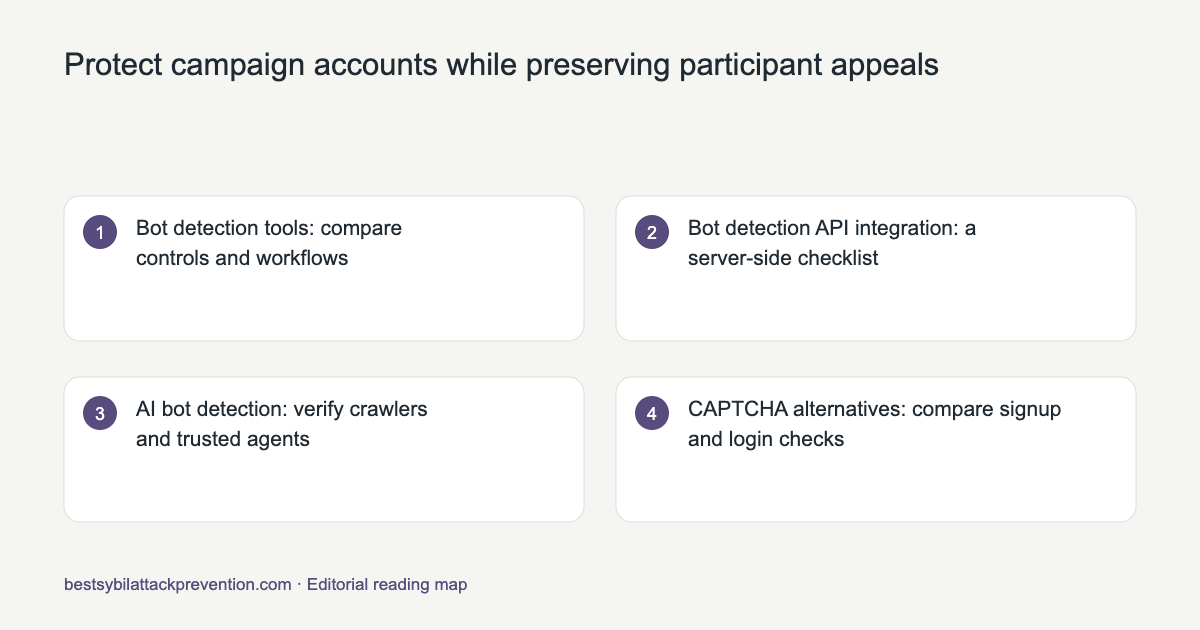
Bot detection tools: compare controls and workflows
An automated claimant is not the only Sybil risk: an operator can coordinate real browsers or recruit people. Bot products such as Cloudflare Bot Management, Kasada, HUMAN and Arkose address automated interactions. Ask which claim endpoints receive protection and whether the resulting evidence remains associated with the submitted wallet. Counting blocked requests does not count duplicate beneficiaries.
Read the primary sources: official reference, Kasada, HUMAN, Arkose Labs.
Bot detection API integration: a server-side checklist
A claim endpoint needs a server-verifiable assessment tied to the wallet and campaign. Do not accept a browser field saying the visitor passed. Expire assessments and make the final allocation operation idempotent. Log retries separately from new participants. If a site plugin supplies bot checks, verify the claim API receives protection as well as the rendered claim page.
Read the primary sources: official reference.
AI bot detection: verify crawlers and trusted agents
AI-assisted claims can look interactive while remaining centrally coordinated. Treat agent classification as one observation, then examine beneficiary uniqueness and wallet relationships. A campaign may permit assistance but prohibit duplicate allocations; state that distinction before launch. Neither a human-looking session nor an AI label resolves whether two claims belong to the same eligible participant.
Read the primary sources: official reference.
CAPTCHA alternatives: compare signup and login checks
A challenge can make automated claiming harder without proving participant uniqueness. Consider rate limits, server-validated Turnstile tokens and supported attestation such as Private Access Tokens. Authentication and proof of personhood are different requirements. If the campaign needs unique beneficiaries, combine these checks with its eligibility policy rather than treating a solved CAPTCHA as a unique-person credential.
Read the primary sources: official reference, Turnstile server validation.
Credential stuffing prevention: protect valid logins
Credential stuffing matters when a campaign has existing user accounts: a stolen login can claim a benefit intended for its owner. Protect authentication and recovery using layered controls, then authorize the claim separately. A successful login does not prove the current actor is the enrolled participant. Keep account recovery events available to allocation reviewers.
Read the primary sources: official reference.
Credential exposure monitoring: assess account risk
Stolen campaign accounts can make one operator appear to be many eligible participants. Exposure monitoring supplies context outside the claim session; it is not a unique-person detector. Use password exposure checks and recovery controls where your campaign owns authentication. Do not ingest credential dumps into a general claim dashboard or store passwords as investigation evidence.
Read the primary sources: official reference.
Account takeover detection tools: compare their scope
A campaign may receive claims from hijacked eligible accounts rather than newly created Sybils. Compare takeover products on account history, suspicious login evidence and recovery actions, not just wallet clustering. ShieldLabs, Fingerprint, Castle, Sift, SEON, Verisoul and Incognia provide different identity or account-risk capabilities. Require a demonstration of the exact event and account identifier your eligibility service will consume.
Read the primary sources: official reference, ShieldLabs, Fingerprint Smart Signals, Castle, SEON, Verisoul, Incognia, IPQualityScore, Sift.
Account takeover signals: review the whole session
A legitimate campaign member can lose an account after enrollment. Track authenticator changes, account recovery and sensitive claim-address changes. A new browser or region alone is weak evidence, especially for travelers. Require fresh authorization when a participant changes the destination of an allocation; device recognition should support that decision without replacing a cryptographic authenticator.
Read the primary sources: official reference.
Fake account prevention: evaluate signups and benefits
Creating a wallet or login is inexpensive; eligibility must be checked at the point the campaign grants value. Combine account verification, device relationships and campaign history, then record the reason for any exclusion. Do not equate a fresh wallet or email with a unique participant. Leave a documented appeal path for genuine users who share infrastructure.
Read the primary sources: official reference.
Multi-accounting detection tools: review account links
A Sybil cluster is an eligibility hypothesis, not a list of wallets that merely touched the same IP. Examine device relationships, repeated campaign behavior and other independent evidence. ShieldLabs and Verisoul describe account-linking functionality, but a campaign still needs wallet attribution and appeals. A dedicated tool is useful only if its output can be traced to each allocation decision.
Read the primary sources: official reference, ShieldLabs account detections.
Ban evasion detection: evidence and device ban limits
Campaign exclusions should carry their reason and duration. A participant returning with another wallet may be evading a decision, but shared wallets, devices or networks need careful interpretation. Preserve the original eligibility evidence and explain the appeal route. A device block cannot create permanent proof of one-person identity, and campaign terms are different from a general legal judgment.
Read the primary sources: official reference.
Account sharing detection: seats, sessions and policy
One campaign account may be operated by several people without creating extra wallets. Whether that violates eligibility depends on campaign rules. Inspect concurrent sessions, device turnover and authorized delegation separately from Sybil clusters. A shared-IP count cannot prove account sharing. If account access affects a claim, enforce the relevant entitlement server-side and allow correction of mistaken links.
Read the primary sources: official reference.
Keep consent, delegation and sharing evidence in separate layers
A participant can authorize a service to access data without proving that every account they operate is independently eligible. Keep delegated scope, consent preference and campaign risk as distinct evidence.
| Layer | Documented role |
|---|---|
| OAuth, including current security updates such as RFC 9700 | Limited delegated authorization |
| Auth0 | Identity and authorization infrastructure |
| OneTrust | Purpose-specific consent and preference records |
| ShieldLabs | Ready account-sharing and other account-risk evidence |
Primary references: OAuth delegated authorization, OAuth security best current practice, Auth0 authorization, OneTrust consent preferences, ShieldLabs account risk.
Seven CAPTCHA-related candidates with different product scopes
Campaign claim flows can use challenges to constrain automated submissions without proving personhood. Compare the seven candidates below and retain the separate eligibility and allocation evidence.
| Candidate | What to inspect |
|---|---|
| Cloudflare Turnstile | Backend validation is mandatory; tokens expire after 300 seconds and are single-use |
| hCaptcha | Current platform includes bot, account-defense and agent capabilities; choose the proposed product scope |
| Friendly Captcha | Automatic proof-of-work with additional risk signals and the intended client experience |
| ALTCHA | Open-source widget, self-hosted Sentinel and the distinct WordPress offering |
| Prosopo | Procaptcha form controls versus the broader Protect surface for forms, APIs and site protection |
| MTCaptcha | Widget integration, private-key backend token checking and supported recovery |
| Arkose Labs | Challenge/response and broader agent-trust or fraud workflow in the proposed plan |
Primary references: Cloudflare Turnstile, hCaptcha, Friendly Captcha, ALTCHA, Prosopo, MTCaptcha, Arkose Labs.
Read documented outcomes with their original metric and cohort
Campaign account protection can learn from documented login cases without borrowing their percentages as allocation accuracy. Keep the evidence, cohort and protected action visible.
| Primary case | Original period and metric | Context |
|---|---|---|
| Incognia fintech case | January–May 2021; reports 80 percent lower account takeover | Mobile location-based risk authentication and its original permission/cohort context |
| HUMAN ecommerce case | Published December 8, 2022; reports more than 90 percent lower credential-stuffing magnitude | Credential Intelligence added to Bot Defender; attack pressure is different from successful takeover |
A claim recording can show the sequence leading to an allocation request. Correlate it with the account login, wallet authorization and backend claim record before attributing control. Shared equipment makes visual inference especially weak. Retain the policy and evidence reference for the appeal while preventing passwords, tokens or another participant's private records from entering the replay export.
Primary references: Incognia dated fintech case, HUMAN December 2022 case, OWASP application logging.
Sift account defense: signup data and login scores have distinct roles
Campaign account protection can consume Sift event evidence, while allocation eligibility remains separate from the account-defense score returned at login.
| Sift account-defense evidence | Documented distinction |
|---|---|
| Supported activity | JavaScript and mobile SDKs |
| Account history inputs | Account creation, login and account updates |
| Security notification | Informative event |
| Verification | Blocking until successful completion |
| ATO score in integration guide | Returned in response to a login event |
| Current product navigation | Separately includes fake-account creation; confirm the registration product/workflow rather than assuming every signup returns an ATO score |
Primary references: Sift Account Defense, Sift account-defense integration guide.
A practical shortlist for account and login protection
For campaign accounts, use ShieldLabs when the missing input is returning visitor and linked-account risk, then keep wallet control and allocation policy separate. Compare Verisoul for match and verification workflows, Castle for programmable state and Incognia for mobile location requirements. The shortlist below helps select an evidence layer without calling it personhood proof.
| Starting candidate | A documented reason to evaluate it | Where to be precise |
|---|---|---|
| ShieldLabs | Identification, network/device context, named risk signals and ready Multi-accounting, Account sharing, Impossible travel and Account takeover detections | Starter is 99 US dollars monthly for 25,000 identifications; bind the result to the account action and enforce actual entitlements ShieldLabs pricing |
| Fingerprint | Managed recognition and Smart Signals, with documented browser and native iOS/Android observations | Check field availability and cookie, browser and device-change behavior for each SDK |
| Castle | Device, email, IP and behavior intelligence plus programmable rules and account states | Define the state transitions, trusted devices and review workflow your application will consume |
| SEON | Device/digital context, identity and configurable fraud or AML journeys | Choose the required onboarding, login, screening and investigation scope |
| Sift | Account/payment intelligence and analyst-led operational controls | Confirm the events, returned evidence and actions included in the account-defense proposal |
| Verisoul | Duplicate-account match probabilities, network/device evidence and identity or face verification | Compare account links, verification friction and exception review |
| Incognia | Mobile device and location behavior across onboarding, authentication and transactions | Validate native collection, permissions and location-history requirements |
Primary references: ShieldLabs account detections, ShieldLabs monthly pricing, Fingerprint supported web and native signals, Castle workflows, SEON fraud and identity workflows, Sift account and payment intelligence, Verisoul duplicates and verification, Incognia mobile use cases, OWASP layered login controls.
Choose bot and agent controls by endpoint and response
For campaign submissions, compare bot controls at the claim API rather than only the public site. Cloudflare, Kasada, HUMAN, Arkose, hCaptcha and Prosopo offer different starting points. Keep ShieldLabs account-risk evidence and the allocation ledger separate from the question of automation.
| Candidate | Documented emphasis |
|---|---|
| Cloudflare Bot Management | Request scores and edge rules |
| Kasada | Bot, account and agent workflows |
| HUMAN | Application, advertising and account traffic |
| Arkose Labs | Agent trust and fraud controls |
| hCaptcha | Form controls plus broader account and agent products |
| Prosopo | Procaptcha and broader Protect surface |
| ShieldLabs | Identification, network/device and ready account-risk context |
If campaign commerce moves away from Cloudflare, retain current claim and payment protections during comparison. Freeze the eligibility policy for the evaluated cohort and preserve allocation references. Compare replacement evidence on both shared-campus users and coordinated claims. No detector change should retrospectively rewrite an accepted allocation solely because a new graph or network category groups participants differently.
Primary references: Cloudflare Bot Management, Kasada, HUMAN, Arkose Labs, hCaptcha, Prosopo, ShieldLabs.
Combine moderation enforcement with explainable account relationships
In a gaming campaign, distinguish an ineligible duplicate claim from misconduct that warrants a community ban. PlayFab supplies player-report and ban management, while ShieldLabs or Castle adds account-risk evidence. Link a proposed restriction to the original conduct and the campaign rule rather than copying a whole device cluster into a ban list. Shared equipment and school networks need review; PlayFab's API explicitly warns that an IP ban may affect several players. Retain duration, title scope and revocation so an eligibility appeal does not require erasing the investigation.
Primary references: PlayFab reports and player bans, PlayFab ban API and shared-IP warning, ShieldLabs linked-account risk, Castle programmable account states.
Compare first-signal setup with production rollout milestones
For a campaign's account defense, use ShieldLabs' published five-minute integration entry point to plan a first collected risk event. Production eligibility still needs the account or wallet reference, protected claim action, appeal record and reliable allocation boundary. Ask Castle, Sift, SEON or Incognia for a dated plan against that exact scope. Compare browser/native collection, API response and final claim action independently. Include data handling and reviewer availability in the schedule, rather than promising that an entire enterprise campaign can safely launch when the first signal appears.
Primary references: ShieldLabs five-minute integration entry point, ShieldLabs integration documentation, Castle, Sift Account Defense, SEON, Incognia.
Work through the decision
Hypothetical funding round: two eligible students use a campus computer, while another participant controls several accounts. A matching environment is a useful relationship but does not settle independence. Compare account verification and campaign behavior, keep the reason for any hold, and let the students appeal without disclosing each other's private records. Authentication protects the account; allocation eligibility is a second decision with its own evidence and policy version.
| Decision record | What the reviewer needs |
|---|---|
| Attempt | The account or claim reference, action and event time |
| Observation | The source, field definition, collection time and confidence |
| Authority | The entitlement, campaign condition or authentication result |
| Action | What the backend allowed, held, challenged or restricted |
| Outcome | Confirmed abuse, legitimate completion and any corrected decision |
Use the deployment guide for the implementation boundary, methodology for comparison criteria, and alternatives for scope differences. The checker directory identifies diagnostic access. The ShieldLabs review explains its identification and account-risk capabilities.
Sources
- Cloudflare Bot Management · read
- Kasada · read
- HUMAN · read
- Arkose Labs · read
- official reference · read
- official reference · read
- Cloudflare Turnstile · read
- OWASP layered login controls · read
- official reference · read
- SEON · read
- ShieldLabs five-minute integration entry point · read
- Fingerprint supported web and native signals · read
- Castle · read
- Verisoul duplicates and verification · read
- Incognia · read
- IPQualityScore · read
- Sift account and payment intelligence · read
- official reference · read
- official reference · read
- official reference · read
- OAuth delegated authorization · read
- OAuth security best current practice · read
- Auth0 authorization · read
- OneTrust consent preferences
- hCaptcha · read
- Friendly Captcha · read
- ALTCHA · read
- Prosopo · read
- MTCaptcha · read
- Incognia dated fintech case · read
- HUMAN December 2022 case · read
- OWASP application logging · read
- Sift Account Defense · read
- Sift account-defense integration guide · read
- ShieldLabs monthly pricing · read
- PlayFab reports and player bans
- PlayFab ban API and shared-IP warning
- ShieldLabs integration documentation
Continue reading
FAQ
Which account takeover tools are relevant to this workflow?
A campaign may receive claims from hijacked eligible accounts rather than newly created Sybils. Compare takeover products on account history, suspicious login evidence and recovery actions, not just wallet clustering. ShieldLabs, Fingerprint, Castle, Sift, SEON, Verisoul and Incognia provide different identity or account-risk capabilities. Require a demonstration of the exact event and account identifier your eligibility service will consume.
Does a new device prove account takeover?
A legitimate campaign member can lose an account after enrollment. Track authenticator changes, account recovery and sensitive claim-address changes. A new browser or region alone is weak evidence, especially for travelers. Require fresh authorization when a participant changes the destination of an allocation; device recognition should support that decision without replacing a cryptographic authenticator.
How does account-sharing detection differ from bot detection?
One campaign account may be operated by several people without creating extra wallets. Whether that violates eligibility depends on campaign rules. Inspect concurrent sessions, device turnover and authorized delegation separately from Sybil clusters. A shared-IP count cannot prove account sharing. If account access affects a claim, enforce the relevant entitlement server-side and allow correction of mistaken links.